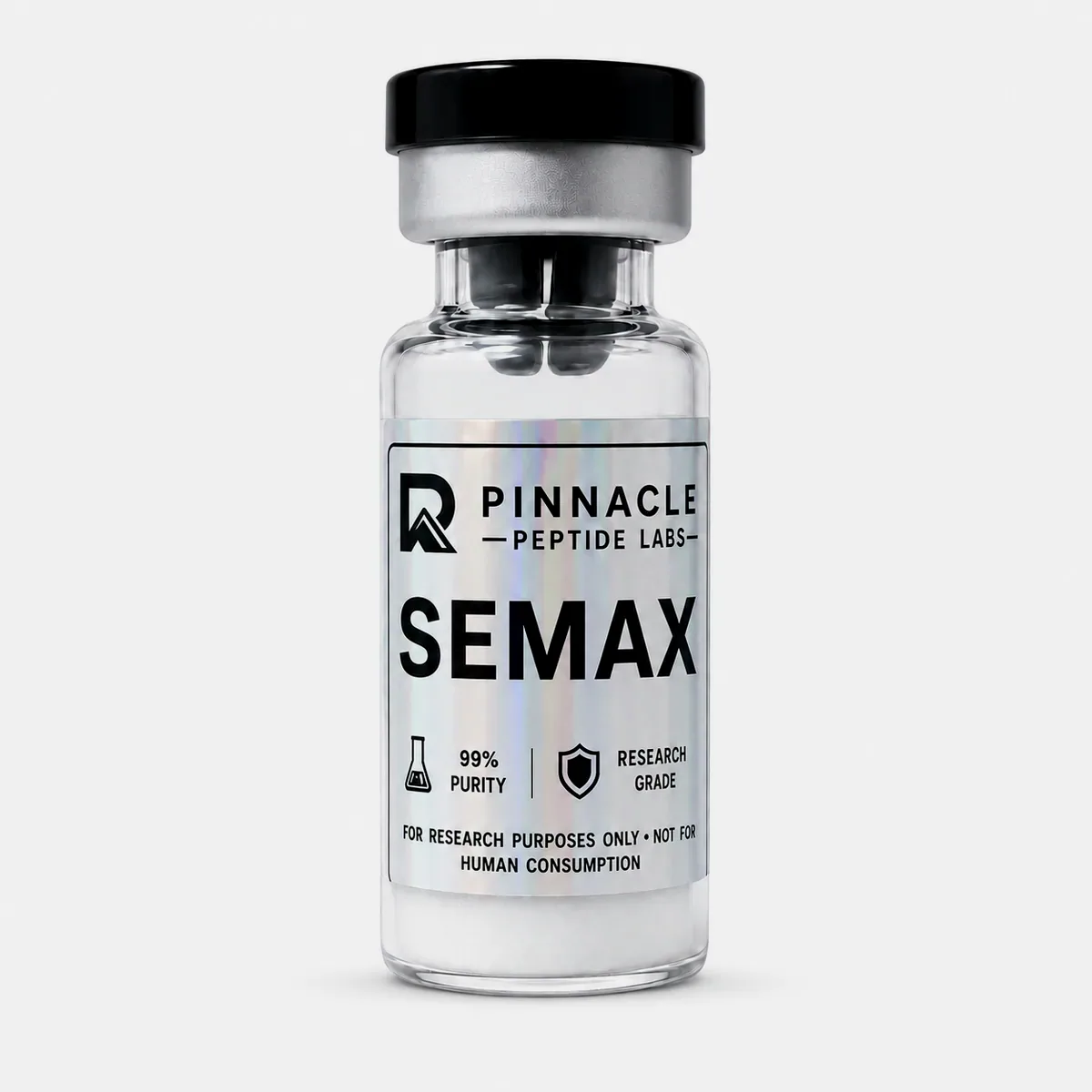
Semax 10mg
ACTH(4-7) Analog Heptapeptide
NOTIFY ME WHEN BACK IN STOCK
Please allow an additional 3 to 5 business days of handling time for this compound.
A heptapeptide ACTH(4-7) analog studied within neurotrophic (BDNF) signaling and neuroprotection research.
- COA included with every vial
- Free U.S. shipping over $200
- Secure encrypted checkout
- ≥99% doctoral chemist verified purity
RESEARCH APPLICATIONS
All products are intended strictly for in-vitro laboratory research and development use only. Not for human or veterinary use, not a drug, food, or cosmetic, and not intended to diagnose, treat, cure, or prevent any disease.
What is Semax studied for in research?
Semax is a synthetic heptapeptide built from the ACTH(4-7) fragment (Met-Glu-His-Phe) with a C-terminal Pro-Gly-Pro extension that improves its stability, and is commonly described in the literature as an ACTH(4-10) analog. It is studied within neurotrophic signaling, including modulation of brain-derived neurotrophic factor (BDNF), and within neuroprotection research models. Semax is registered and used as a medicine in Russia, though it is not approved by the FDA; this material is supplied for research use only. It is a widely referenced nootropic tool compound in CNS research.
SEQUENCE
MEHFPGP
Reconstitution & Handling
Reconstitute with bacteriostatic water. Do not shake vigorously.
Store at -20°C. Protect from light. Reconstitute and refrigerate.
Specifications
- Purity
- ≥99%
- Form
- Lyophilized powder
- Molecular Formula
- C37H51N9O10S
- Molecular Weight
- 813.9 g/mol
- CAS Number
- 80714-61-0
- Strength
- 10mg
Download the Certificate of Analysis
Doctoral chemist purity & identity report
Understand Semax before you order
Semax vs Selank: A Research Comparison
Semax and Selank are both Russian-developed research heptapeptides studied in CNS models, but they descend from unrelated parent molecules and are studied for different pathways. Semax is an ACTH(4-10) analog studied for neurotrophic (BDNF) signaling, while Selank is a tuftsin analog studied for neuropeptide, GABAergic, and immunomodulatory pathways. Both are for research use only.
Semax: Research Overview and Mechanism
Semax is a synthetic heptapeptide analog of an ACTH(4-10) fragment, studied in laboratory and preclinical research within neurotrophic signaling, including BDNF, and neuroprotection models. It is registered as a pharmaceutical in Russia, where it has been used clinically and studied in human research, a regulatory status stated here as public fact. It is supplied as a lyophilized powder for research use only, and this overview describes what it is studied for in research literature, not a therapeutic effect.
Selank: Research Overview and Mechanism
Selank is a synthetic heptapeptide studied in laboratory and preclinical research within neuropeptide signaling, GABAergic and monoaminergic pathways, and tuftsin-related immunomodulation. Its N-terminal segment corresponds to the immunopeptide tuftsin, extended with a proline-glycine-proline sequence that resists enzymatic degradation. It is supplied as a lyophilized powder for research use only and is not approved for human use.
You May Also Research
Selank 10mg
COA included, doctoral chemist tested
A tuftsin-analog heptapeptide studied within neuropeptide signaling and immunomodulation research.
GLP-3RT 20mg
COA included, doctoral chemist tested
A next-generation triple-receptor agonist studied within metabolic, glucose-regulation, and energy-homeostasis research pathways.
MOTS-C 10mg
COA included, doctoral chemist tested
A 16-residue mitochondrial-derived peptide studied within cellular-metabolism and AMPK-signaling research.
Semax Questions, Answered
What is Semax studied for in research?
Semax is studied within neurotrophic signaling, including BDNF modulation, and neuroprotection research models as an ACTH(4-7) analog heptapeptide. It is registered as a medicine in Russia but is not FDA-approved, and this material is for research use only.
What is the difference between Semax and Selank?
Semax derives from an ACTH fragment and Selank from the immunopeptide tuftsin, and they are studied for different pathways. The full side-by-side breakdown is in the Semax vs Selank comparison at /learn/semax-vs-selank.
What mechanisms are studied for Semax?
Research associates Semax with increased expression of neurotrophic factors such as BDNF and with modulation of the melanocortin and monoamine systems in CNS models, which is why it is studied for neuroprotection. These are research findings, not established human effects.
How should Semax be stored?
Semax is kept as a lyophilized powder at -20°C protected from light; after reconstitution with bacteriostatic water the solution is refrigerated and used within the window on the Certificate of Analysis, with freeze-thaw kept to a minimum.