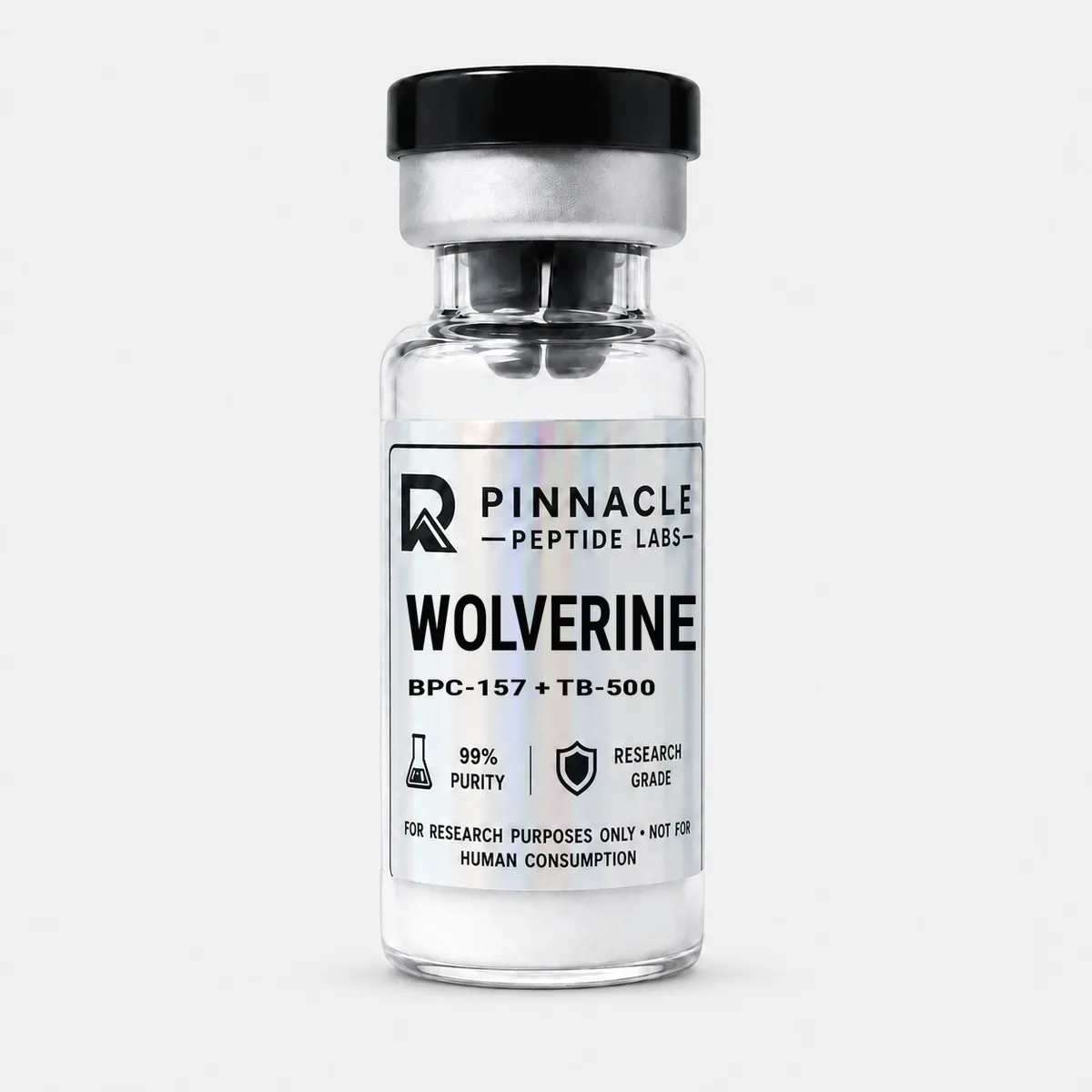
Wolverine 20mg Blend
BPC-157 + TB-500 Research Blend
A two-component research blend of BPC-157 and TB-500, studied across complementary tissue-repair pathways.
- COA included with every vial
- Free U.S. shipping over $200
- Secure encrypted checkout
- ≥99% doctoral chemist verified purity
RESEARCH APPLICATIONS
All products are intended strictly for in-vitro laboratory research and development use only. Not for human or veterinary use, not a drug, food, or cosmetic, and not intended to diagnose, treat, cure, or prevent any disease.
What is Wolverine studied for in research?
Wolverine is a research blend combining BPC-157 and TB-500 in a single vial, studied for complementary tissue-repair pathways: BPC-157 for angiogenesis and cytoprotection, and TB-500, a synthetic fragment of thymosin beta-4, for actin regulation and cell migration. Because it is a two-component mixture it has no single molecular formula, and component ratios are lot-specific and documented on the Certificate of Analysis. It is supplied for research use only.
Reconstitution & Handling
Reconstitute with bacteriostatic water. Do not shake vigorously.
Store at -20°C. Protect from light. Reconstitute and refrigerate.
Specifications
- Purity
- ≥99%
- Form
- Lyophilized powder
- Molecular Formula
- Blend (see COA)
- Molecular Weight
- Blend (see COA)
- CAS Number
- Blend (see COA)
- Strength
- 20mg Blend
Download the Certificate of Analysis
Doctoral chemist purity & identity report
Understand Wolverine before you order
BPC-157: Research Overview and Mechanism
BPC-157 is a synthetic pentadecapeptide derived from a partial sequence of a gastric protein, studied in laboratory and preclinical research within angiogenesis, cytoprotection, and tissue-repair pathways. It is one of the most frequently referenced tool compounds in tissue-repair research literature. It is supplied as a lyophilized powder for research use only and is not approved for human use.
Wolverine: Research Overview and Mechanism
Wolverine is a two-component research blend combining BPC-157 and TB-500 in a single vial, studied across complementary tissue-repair pathways in laboratory and preclinical models. BPC-157 is studied for angiogenesis and cytoprotection, and TB-500, a thymosin beta-4 fragment, is studied for cell migration and actin regulation. As a multi-component blend it has no single molecular formula; component ratios are documented on the lot-matched Certificate of Analysis. It is for research use only and is not approved for human use.
You May Also Research
GLOW-70 70mg Blend
COA included, doctoral chemist tested
A tri-peptide research blend combining GHK-Cu, BPC-157, and TB-500, studied for tissue-repair and cellular-regeneration pathways.
GLP-3RT 20mg
COA included, doctoral chemist tested
A next-generation triple-receptor agonist studied within metabolic, glucose-regulation, and energy-homeostasis research pathways.
MOTS-C 10mg
COA included, doctoral chemist tested
A 16-residue mitochondrial-derived peptide studied within cellular-metabolism and AMPK-signaling research.
Wolverine Questions, Answered
What is in the Wolverine research blend?
Wolverine combines BPC-157 and TB-500 in a single lyophilized vial, with exact component quantities documented on the accompanying Certificate of Analysis. It is for research use only.
Why are BPC-157 and TB-500 blended together?
They are studied across complementary tissue-repair pathways: BPC-157 for angiogenesis and cytoprotection, and TB-500 for actin regulation and cell migration, which is why the two are combined in research blends.
What is TB-500 in the blend?
TB-500 is a synthetic fragment of the protein thymosin beta-4, studied in research for its role in binding actin and supporting cell migration during tissue remodeling. In this blend it complements the angiogenic focus of BPC-157.
Does the Wolverine blend have a single molecular formula?
No. As a two-component blend it has no single formula or CAS number, so the identity and quantity of each component are reported on the lot-matched Certificate of Analysis rather than as one molecular weight.