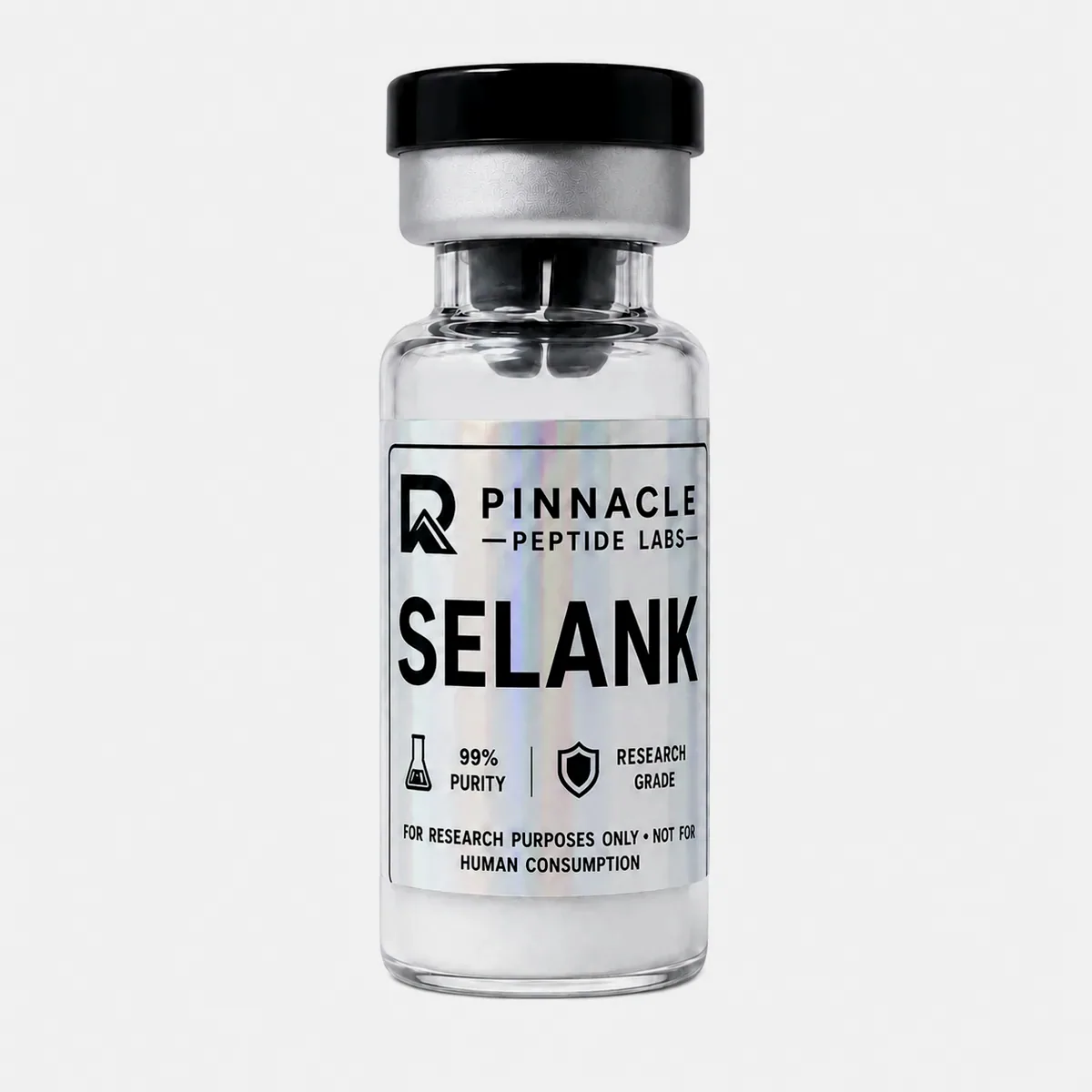
Selank 10mg
Tuftsin-Analog Heptapeptide
NOTIFY ME WHEN BACK IN STOCK
Please allow an additional 3 to 5 business days of handling time for this compound.
A tuftsin-analog heptapeptide studied within neuropeptide signaling and immunomodulation research.
- COA included with every vial
- Free U.S. shipping over $200
- Secure encrypted checkout
- ≥99% doctoral chemist verified purity
RESEARCH APPLICATIONS
All products are intended strictly for in-vitro laboratory research and development use only. Not for human or veterinary use, not a drug, food, or cosmetic, and not intended to diagnose, treat, cure, or prevent any disease.
What is Selank studied for in research?
Selank is a synthetic heptapeptide whose N-terminal segment is the immunopeptide tuftsin, extended with a proline-glycine-proline sequence for stability. It is studied within neuropeptide signaling, GABAergic and monoamine modulation, and tuftsin-related immunomodulation research models. Selank is registered and used as a medicine in Russia, though it is not approved by the FDA; this material is supplied for research use only.
SEQUENCE
TKPRPGP
Reconstitution & Handling
Reconstitute with bacteriostatic water. Do not shake vigorously.
Store at -20°C. Protect from light. Reconstitute and refrigerate.
Specifications
- Purity
- ≥99%
- Form
- Lyophilized powder
- Molecular Formula
- C33H57N11O9
- Molecular Weight
- 751.9 g/mol
- CAS Number
- 129954-34-3
- Strength
- 10mg
Download the Certificate of Analysis
Doctoral chemist purity & identity report
Understand Selank before you order
Semax vs Selank: A Research Comparison
Semax and Selank are both Russian-developed research heptapeptides studied in CNS models, but they descend from unrelated parent molecules and are studied for different pathways. Semax is an ACTH(4-10) analog studied for neurotrophic (BDNF) signaling, while Selank is a tuftsin analog studied for neuropeptide, GABAergic, and immunomodulatory pathways. Both are for research use only.
Semax: Research Overview and Mechanism
Semax is a synthetic heptapeptide analog of an ACTH(4-10) fragment, studied in laboratory and preclinical research within neurotrophic signaling, including BDNF, and neuroprotection models. It is registered as a pharmaceutical in Russia, where it has been used clinically and studied in human research, a regulatory status stated here as public fact. It is supplied as a lyophilized powder for research use only, and this overview describes what it is studied for in research literature, not a therapeutic effect.
Selank: Research Overview and Mechanism
Selank is a synthetic heptapeptide studied in laboratory and preclinical research within neuropeptide signaling, GABAergic and monoaminergic pathways, and tuftsin-related immunomodulation. Its N-terminal segment corresponds to the immunopeptide tuftsin, extended with a proline-glycine-proline sequence that resists enzymatic degradation. It is supplied as a lyophilized powder for research use only and is not approved for human use.
You May Also Research
Semax 10mg
COA included, doctoral chemist tested
A heptapeptide ACTH(4-7) analog studied within neurotrophic (BDNF) signaling and neuroprotection research.
GLP-3RT 20mg
COA included, doctoral chemist tested
A next-generation triple-receptor agonist studied within metabolic, glucose-regulation, and energy-homeostasis research pathways.
MOTS-C 10mg
COA included, doctoral chemist tested
A 16-residue mitochondrial-derived peptide studied within cellular-metabolism and AMPK-signaling research.
Selank Questions, Answered
What is Selank studied for in research?
Selank is studied within neuropeptide signaling, GABAergic modulation, and tuftsin-related immunomodulation research models. It is registered as a medicine in Russia but is not FDA-approved, and this material is for research use only.
What is Selank derived from?
Selank's N-terminal tetrapeptide is tuftsin, an immunomodulatory peptide, extended with proline-glycine-proline, which is why it is studied at the intersection of neuropeptide and immunomodulation research.
How does Selank compare with Semax?
Both are Russian-developed research heptapeptides for CNS models, but Selank derives from tuftsin and Semax from an ACTH fragment. The full comparison is in the Semax vs Selank guide at /learn/semax-vs-selank.
Is Selank doctoral chemist tested?
Yes. Every batch ships with a lot-matched Certificate of Analysis confirming identity and purity of 99% or higher by HPLC and mass spectrometry of the seven-residue sequence.