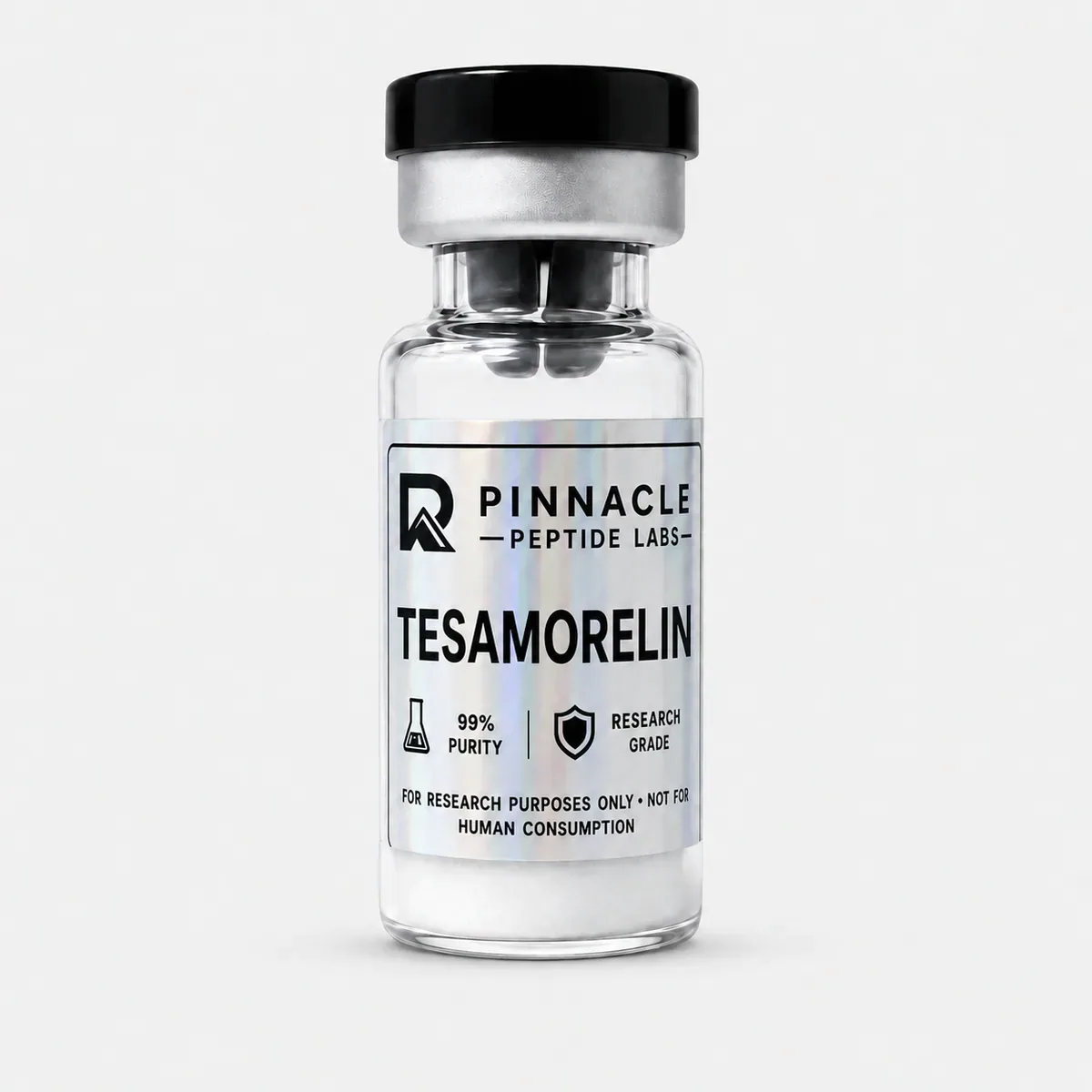
Tesamorelin 10mg
Stabilized GHRH(1-44) Analog
A stabilized growth hormone-releasing factor analog studied for its effects on GH secretion pathways in laboratory models.
- COA included with every vial
- Free U.S. shipping over $200
- Secure encrypted checkout
- ≥99% doctoral chemist verified purity
RESEARCH APPLICATIONS
All products are intended strictly for in-vitro laboratory research and development use only. Not for human or veterinary use, not a drug, food, or cosmetic, and not intended to diagnose, treat, cure, or prevent any disease.
What is Tesamorelin studied for in research?
Tesamorelin is a synthetic analog of growth hormone-releasing hormone (GHRH) with an N-terminal trans-3-hexenoyl group that slows enzymatic degradation and improves stability relative to native GHRH. As a GHRH-receptor agonist it is studied within the somatotropic axis, GH-secretion dynamics, and lipid-metabolism endpoints in controlled models. The molecule tesamorelin is approved by the FDA as Egrifta and has been investigated in human clinical trials for visceral adipose tissue endpoints; the material offered here is supplied strictly as a research reagent and is not for human use.
SEQUENCE
(trans-3-hexenoyl)-YADAIFTNSYRKVLGQLSARKLLQDIMSRQQGESNQERGARARL-NH2
Reconstitution & Handling
Reconstitute with bacteriostatic water. Do not shake vigorously.
Store at -20°C. Protect from light. Reconstitute and refrigerate.
Specifications
- Purity
- ≥99%
- Form
- Lyophilized powder
- Molecular Formula
- C221H366N72O67S
- Molecular Weight
- 5135.9 g/mol
- CAS Number
- 218949-48-5
- Strength
- 10mg
Download the Certificate of Analysis
Doctoral chemist purity & identity report
Understand Tesamorelin before you order
What Are Research Peptides? A Complete Guide
Research peptides are short chains of amino acids (typically 2 to 50 residues) synthesized for use in controlled laboratory and preclinical research. They are supplied as lyophilized (freeze-dried) powder, reconstituted before study, and are intended strictly for in-vitro research use, not for human or veterinary consumption. Quality is defined by verified purity, confirmed molecular identity, and a batch-specific Certificate of Analysis from an independent laboratory.
Peptide Reconstitution and Storage: A Laboratory Guide
Lyophilized research peptides are reconstituted by slowly adding a suitable solvent (commonly bacteriostatic water) down the side of the vial, then gently swirling rather than shaking until dissolved. Store the unreconstituted powder at -20°C protected from light; refrigerate the reconstituted solution and use it within the window indicated on the Certificate of Analysis. Correct handling preserves purity and experimental reproducibility.
How to Choose a Research Peptide Supplier
Choose a research peptide supplier by verifying seven things: independent third-party testing, Certificates of Analysis matched to your exact lot number, a clearly stated purity threshold, molecular-identity confirmation by mass spectrometry, transparent manufacturing and sourcing, proper research-use-only positioning with no human-use claims, and responsive documentation-first support. Any supplier that markets peptides for human consumption or hides its test data should be avoided.
You May Also Research
CJC-1295 / Ipamorelin 5mg/5mg Blend
COA included, doctoral chemist tested
A two-component research blend of CJC-1295 (a modified GRF(1-29) GHRH analog) and Ipamorelin (a selective ghrelin-receptor agonist), studied together within growth hormone-secretion research.
GLP-3RT 20mg
COA included, doctoral chemist tested
A next-generation triple-receptor agonist studied within metabolic, glucose-regulation, and energy-homeostasis research pathways.
MOTS-C 10mg
COA included, doctoral chemist tested
A 16-residue mitochondrial-derived peptide studied within cellular-metabolism and AMPK-signaling research.
Tesamorelin Questions, Answered
What is Tesamorelin used for in research?
Tesamorelin is used in laboratory research to study GHRH-receptor activity, GH-secretion dynamics, and lipid-metabolism endpoints in controlled models. The molecule is approved as Egrifta and has been investigated in human clinical trials for visceral adipose tissue, but this material is for research use only and not for human use.
What makes Tesamorelin more stable than native GHRH?
Its N-terminal trans-3-hexenoyl modification slows cleavage by dipeptidyl peptidase-4 and other proteases, which is studied as the basis of its longer research half-life compared with the unmodified GHRH sequence.
How does Tesamorelin compare with Sermorelin?
Both are GHRH analogs, but Sermorelin is the short unmodified GHRH(1-29) fragment while Tesamorelin is a stabilized, near-full-length analog. The full comparison is in the Sermorelin vs Tesamorelin guide at /learn/sermorelin-vs-tesamorelin.
How should Tesamorelin be stored?
Tesamorelin is stored as a lyophilized powder at -20°C protected from light; after reconstitution with bacteriostatic water it is refrigerated and used within the timeframe recorded on the Certificate of Analysis.