Peptide Storage and Shelf Life: A Research Guide
In dry, lyophilized form a research peptide is at its most stable, and when it is kept sealed at -20°C away from light and moisture it holds its integrity for an extended period. Once reconstituted, the same peptide is in solution and far less stable, so it is refrigerated and used within a much shorter window. Shelf life is not a single fixed number: it depends on the compound, the storage temperature, and how many freeze-thaw cycles the material has seen, so always defer to the stability window stated on the lot's Certificate of Analysis.
Lyophilized shelf life versus reconstituted shelf life
The two forms of a research peptide have very different stabilities. Freeze-dried (lyophilized) powder has had its water removed, which slows the chemical reactions that break peptides down. Held frozen and sealed, it is the long-life form, which is why peptides are shipped and stored as powder rather than pre-mixed solution.
A reconstituted solution is the opposite. Water reintroduces the conditions for hydrolysis, oxidation, and aggregation, so a dissolved peptide has a shelf life measured in weeks under refrigeration rather than the longer horizon of the frozen powder. The exact usable window belongs on the lot documentation, not to a guess.
What actually degrades a stored peptide
Four environmental factors do most of the damage. Heat accelerates every degradation reaction, which is why cold storage matters. Moisture reintroduces water to a form that was dried precisely to exclude it. Light can drive photo-oxidation of sensitive residues. Air exposure allows oxidation and, in an opened vial, microbial contamination.
Because these factors compound, good storage is about controlling all of them at once: sealed, cold, dark, and dry for the powder; refrigerated, capped, and promptly used for the solution. Degraded material is not merely weaker, it introduces the kind of hidden variable that quietly undermines whether one experiment can be compared to the next.
Freeze-thaw cycles and aliquoting
Repeatedly freezing and thawing a peptide solution is one of the most avoidable causes of degradation. Each cycle forms and melts ice crystals and shifts local concentrations, mechanical and chemical stresses that can denature or fragment the molecule. The damage accumulates cycle by cycle.
The standard laboratory answer is to divide a reconstituted stock into small single-use portions, or aliquots, and freeze those separately. Thawing one aliquot leaves the rest untouched at temperature, so the material is only ever frozen and thawed once. Label each aliquot with the compound, lot, and date so its handling history is never in question.
Reading shelf life from your documentation
Treat any general rule of thumb as a starting point, not the final word. The compound itself matters: a small, robust sequence and a large, modification-heavy peptide do not age at the same rate, and a supplier's stability data reflects the specific material.
The reliable reference is the lot-matched Certificate of Analysis and the storage guidance supplied with the vial. Use the stated window, keep the storage conditions it assumes, and record when a vial was reconstituted so you always know where it sits in its usable life.
All products are intended strictly for in-vitro laboratory research and development use only. Not for human or veterinary use, not a drug, food, or cosmetic, and not intended to diagnose, treat, cure, or prevent any disease.
Related research peptides
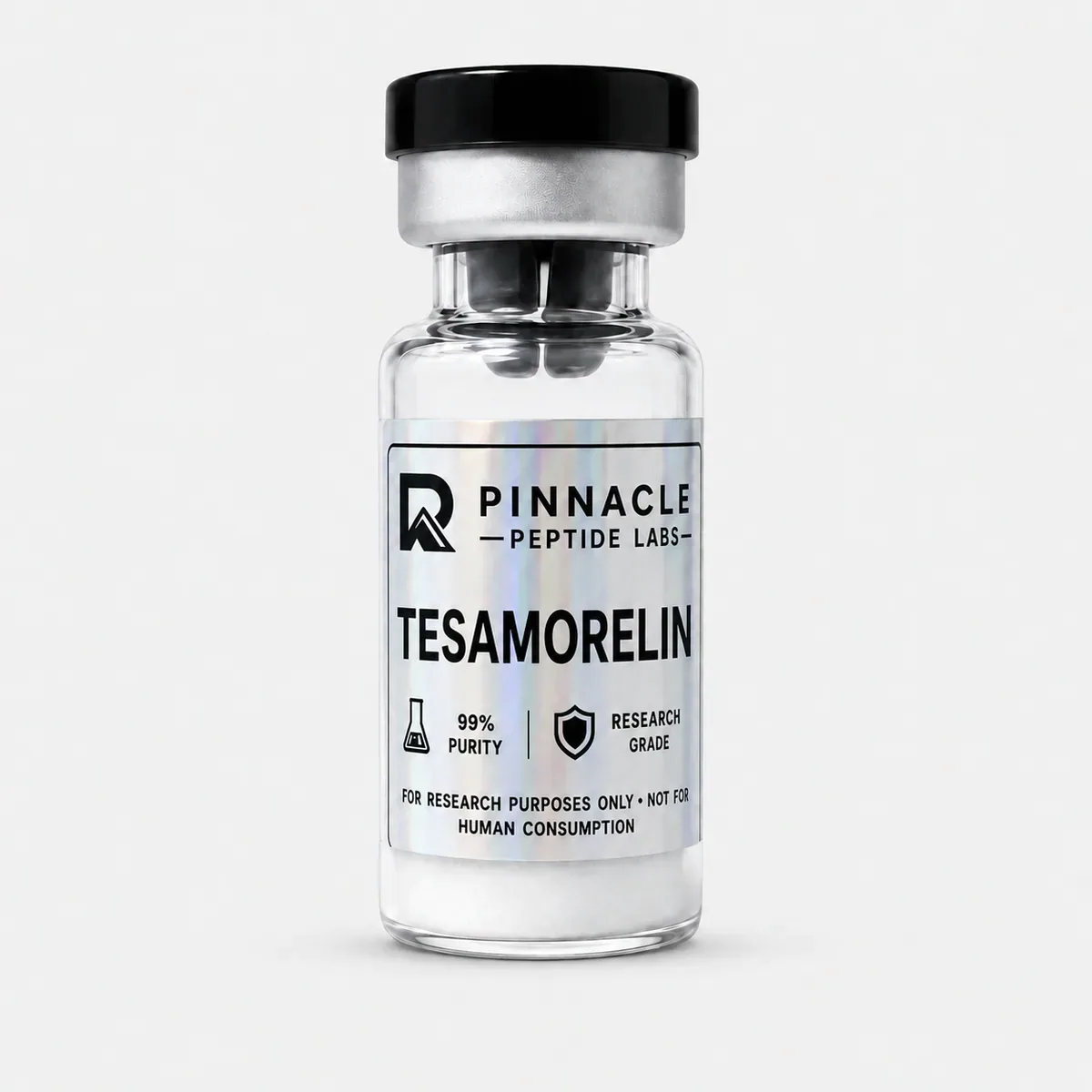
Tesamorelin 10mg
COA included, doctoral chemist tested
A stabilized growth hormone-releasing factor analog studied for its effects on GH secretion pathways in laboratory models.