Sermorelin: Research Overview and Mechanism
Sermorelin is GRF(1-29), the shortest fully active N-terminal fragment of growth hormone-releasing hormone, studied in laboratory and preclinical research as a GHRH-receptor agonist within somatotroph signaling and growth hormone-secretion models. It is supplied as a lyophilized powder for research use only and is not approved for human use. Its former U.S. regulatory history as the molecule once marketed as Geref is noted here as public fact about the compound, not a therapeutic property of this research material.
What Sermorelin is
Sermorelin is GRF(1-29): the first 29 amino acids of growth hormone-releasing hormone (GHRH), which is the shortest N-terminal segment that retains full activity at the GHRH receptor. Its sequence is YADAIFTNSYRKVLGQLSARKLLQDIMSR-NH2, with a molecular weight near 3358 g/mol.
Because it reproduces the active core of GHRH in a shorter, more tractable form, Sermorelin is a compact research tool for studying the GHRH receptor and the somatotropic axis without the full-length hormone.
Pathways it is studied within
In research, Sermorelin is studied for GHRH-receptor agonism, growth hormone-secretion pathways, somatotroph signaling, and GHRH structure-function relationships. Acting on the GHRH receptor, a Gs-coupled receptor, it stimulates adenylate cyclase and cyclic-AMP signaling in somatotrophs, the mechanism that lets GRF(1-29) reproduce the activity of the full hormone in a shorter chain. It is often referenced alongside longer-acting GHRH analogs such as CJC-1295 and Tesamorelin as a point of structure-activity comparison; the length-and-stability contrast with the 44-residue analog is treated in full in our Sermorelin vs Tesamorelin comparison.
Sermorelin also carries a documented regulatory history as a molecule: sermorelin acetate was approved by the U.S. Food and Drug Administration and marketed under the brand name Geref for growth-hormone-deficiency assessment and treatment before it was discontinued from the market in 2008. That history is stated here as public regulatory fact about the compound and does not describe this product, which is supplied for research use only and is not approved for human use.
Handling and documentation
Pinnacle Sermorelin is a 29-residue lyophilized peptide (molecular weight near 3358 g/mol) whose sequence includes a methionine residue that is susceptible to oxidation, so it is stored at -20C, protected from light and air, and reconstituted with bacteriostatic water only when needed. Every batch is independently tested by HPLC and mass spectrometry and ships with a lot-matched Certificate of Analysis confirming identity and purity, which for an oxidation-sensitive fragment is the reference point for verifying an intact molecule.
All products are intended strictly for in-vitro laboratory research and development use only. Not for human or veterinary use, not a drug, food, or cosmetic, and not intended to diagnose, treat, cure, or prevent any disease.
Related research peptides
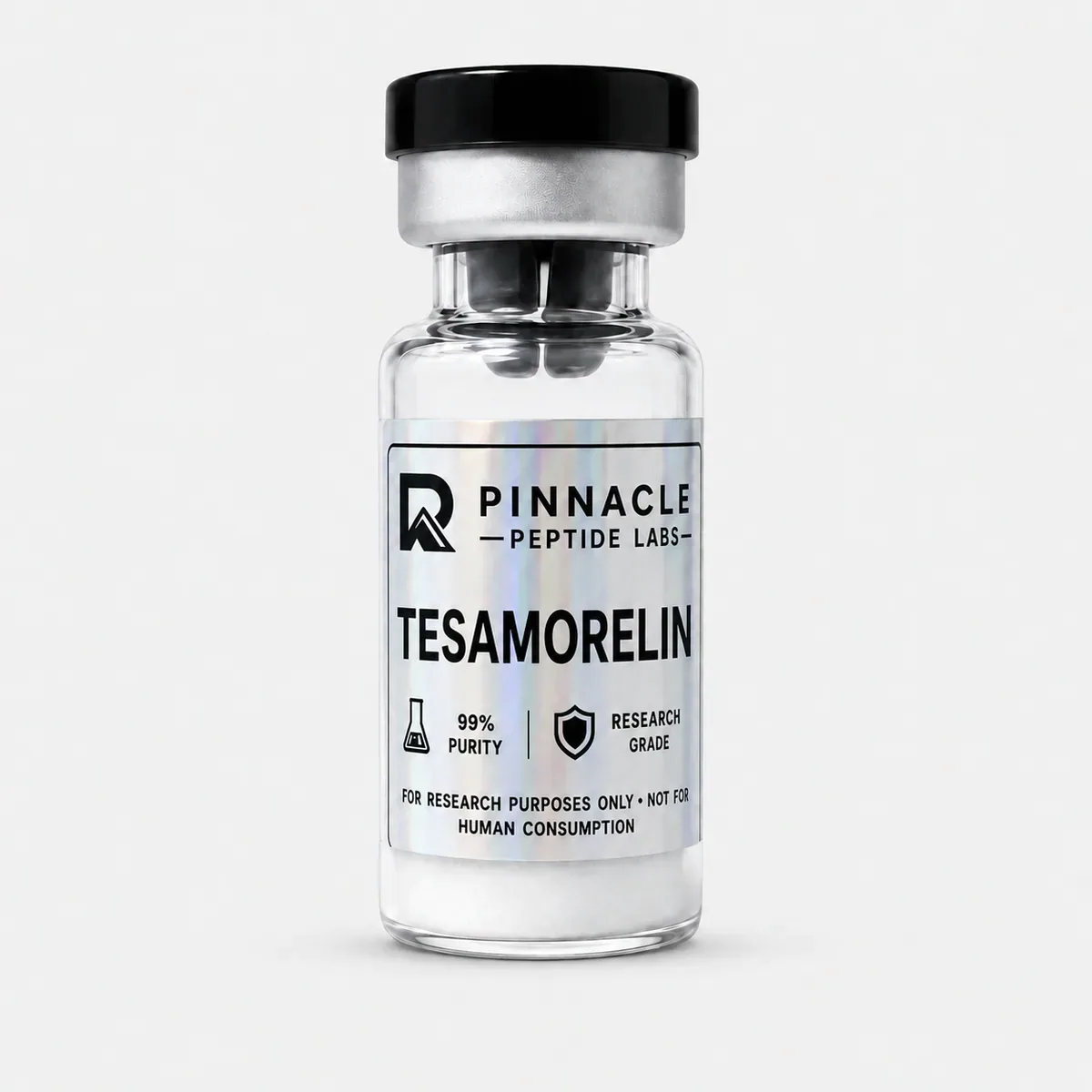
Tesamorelin 10mg
COA included, doctoral chemist tested
A stabilized growth hormone-releasing factor analog studied for its effects on GH secretion pathways in laboratory models.