Sermorelin vs Tesamorelin: A Research Comparison
Sermorelin and Tesamorelin both act on the GHRH receptor, so the comparison turns on length, stability, and regulatory history rather than target. Sermorelin is GRF(1-29), the shortest fragment that retains full GHRH activity; Tesamorelin is a longer, stabilized 44-residue analog. Their histories diverge sharply: Tesamorelin is an approved drug while Sermorelin was previously marketed and later discontinued. Both are supplied here as research-use-only materials, distinct from any approved product.
The core difference: fragment length and stability
Both compounds engage the same GHRH receptor, so the distinction is structural and pharmacokinetic. Sermorelin corresponds to the first 29 residues of GHRH, the shortest N-terminal segment that retains full receptor activity, which makes it the minimal active GHRH tool. Tesamorelin is a longer analog spanning the 44-residue GHRH sequence and carrying an N-terminal trans-3-hexenoyl modification studied for resistance to enzymatic degradation and a longer research half-life than native GHRH.
Structure and molecular profile
Sermorelin (molecular weight near 3357.9 g/mol) is a compact 29-residue GHRH fragment. Tesamorelin (molecular weight near 5135.9 g/mol) is the larger molecule, extending through residue 44 and carrying its stabilizing N-terminal group. Exact salt form and modification should be confirmed against each lot-matched Certificate of Analysis, since acylated analogs can vary by counter-ion.
Clinical and regulatory context
This pair is unusual in that both molecules have documented regulatory histories. Tesamorelin is an approved drug, marketed as Egrifta and indicated for HIV-associated lipodystrophy, and has been studied in human clinical research within growth hormone and lipid-metabolism endpoints. Sermorelin was previously marketed under the brand name Geref and used in growth-hormone-related clinical contexts before being discontinued in the United States. Those facts describe regulated or formerly regulated pharmaceutical products; the Sermorelin and Tesamorelin supplied here are research-use-only materials and are not those approved medicines.
How each is studied
Both are used to investigate GHRH-receptor agonism, pulsatile GH-secretion dynamics, and somatotroph signaling. Tesamorelin is additionally a common choice where the research question extends to lipid metabolism or visceral-adiposity endpoints, reflecting the area its approved counterpart was studied in. A protocol favors Sermorelin when a minimal, well-characterized active fragment is wanted, and Tesamorelin when a stabilized longer analog better fits the design.
All products are intended strictly for in-vitro laboratory research and development use only. Not for human or veterinary use, not a drug, food, or cosmetic, and not intended to diagnose, treat, cure, or prevent any disease.
Related research peptides
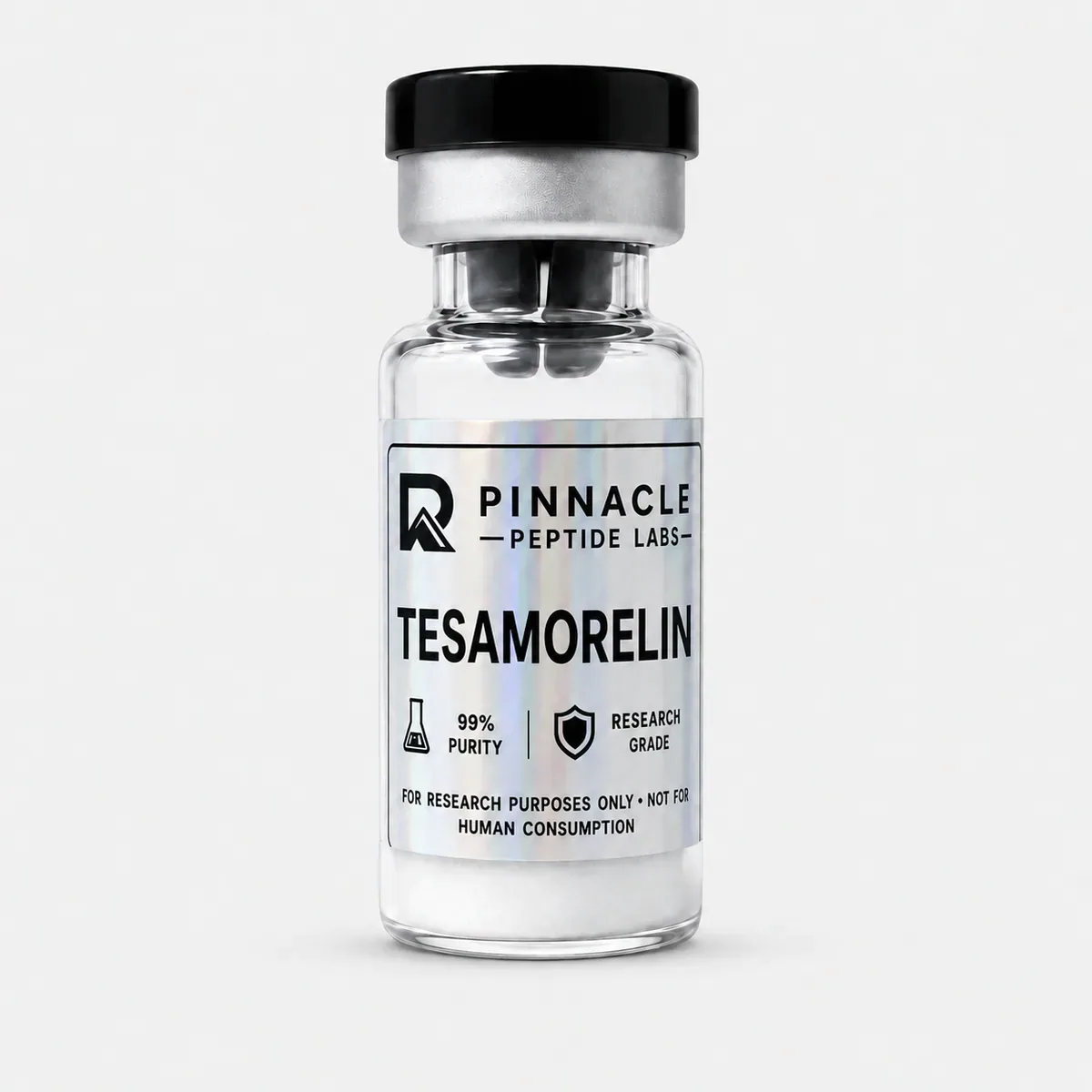
Tesamorelin 10mg
COA included, doctoral chemist tested
A stabilized growth hormone-releasing factor analog studied for its effects on GH secretion pathways in laboratory models.