CJC-1295: Research Overview and Mechanism
CJC-1295 is a modified GRF(1-29) analog of growth hormone-releasing hormone (GHRH) studied in laboratory and preclinical research within the somatotropic axis. It is offered in a no-DAC (Modified GRF 1-29) variant and a longer-acting DAC variant that binds serum albumin to extend research half-life. It is supplied as a lyophilized powder for research use only and is not approved for human use.
What CJC-1295 is
CJC-1295 is a synthetic analog of GRF(1-29), the active N-terminal fragment of growth hormone-releasing hormone (GHRH). It is studied as a GHRH-receptor agonist tool compound within the somatotropic axis, where the GHRH receptor is a Gs-coupled receptor on pituitary somatotrophs whose activation raises cAMP and drives growth-hormone synthesis and pulsatile release. The no-DAC variant, also called Modified GRF 1-29, carries four stabilizing amino acid substitutions that are studied for resisting enzymatic degradation, notably cleavage by dipeptidyl peptidase-IV (DPP-IV), relative to the native fragment.
The DAC (Drug Affinity Complex) variant adds a C-terminal maleimidopropionyl group that forms a covalent bond with a free thiol on circulating serum albumin, an in-situ bioconjugation studied as a mechanism for extending the compound's research half-life. The two variants differ in molecular formula, weight, and CAS number, so the specific form should be confirmed against the supplier Certificate of Analysis.
Pathways it is studied within
Research using CJC-1295 examines GHRH-receptor agonism, growth-hormone-secretion dynamics, and somatotroph signaling within the somatotropic axis. The DAC variant additionally supports peptide-half-life research, since its albumin-binding design is studied as a way to prolong activity relative to the shorter-acting no-DAC form.
These are described as research applications reported in the literature, not human effects. The compound is used as a tool for isolating GHRH-pathway signaling in laboratory and preclinical models.
Research literature
A 2006 report in the American Journal of Physiology, Endocrinology and Metabolism described CJC-1295 as a long-acting GHRH analog that normalized growth in a GHRH-knockout mouse model, illustrating its characterization in preclinical research. This overview refers to that research record and does not describe a human effect.
Handling and documentation
Pinnacle CJC-1295 is supplied as a 5mg lyophilized powder, stored at -20°C protected from light and reconstituted with bacteriostatic water without vigorous shaking. Which variant a vial contains changes its specification: the no-DAC form (Modified GRF 1-29, near 3368 g/mol, CAS 863288-34-0) and the DAC form (near 3647 g/mol, CAS 446262-90-4) differ in molecular formula, weight, and CAS number, so confirm the variant against its lot-matched Certificate of Analysis, which reports identity and 99% or higher purity by HPLC and mass spectrometry.
All products are intended strictly for in-vitro laboratory research and development use only. Not for human or veterinary use, not a drug, food, or cosmetic, and not intended to diagnose, treat, cure, or prevent any disease.
Related research peptides
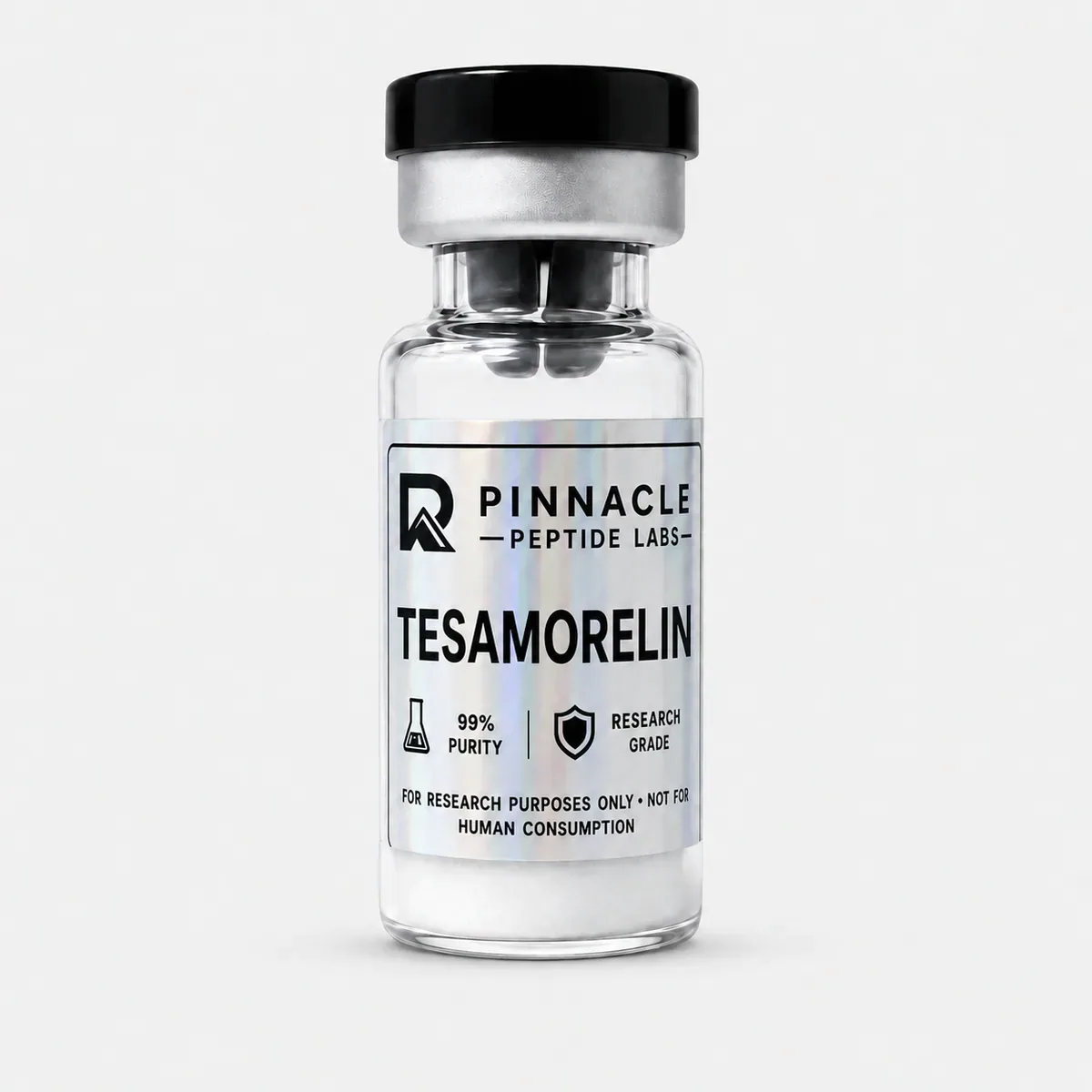
Tesamorelin 10mg
COA included, doctoral chemist tested
A stabilized growth hormone-releasing factor analog studied for its effects on GH secretion pathways in laboratory models.