HGH Fragment 176-191: Research Overview and Mechanism
HGH Fragment 176-191 is a 16-residue C-terminal fragment of human growth hormone, studied in laboratory and preclinical research within lipolysis and GH structure-activity models. It retains the native cysteine-cysteine disulfide bridge and differs from AOD-9604 only by its N-terminal residue. It is supplied as a lyophilized powder for research use only and is not approved for human use.
What HGH Fragment 176-191 is
HGH Fragment 176-191 is a synthetic peptide corresponding to the C-terminal 176 to 191 region of human growth hormone. At 16 residues it retains the native cysteine-cysteine disulfide bridge of that region, a structural feature studied in growth hormone fragment structure-function research.
Because it represents only the C-terminal fragment rather than the intact hormone, it is used as a tool compound for isolating that portion of the growth hormone molecule in laboratory research, distinct from full-length growth hormone and from the GHRH-analog secretagogues.
Pathways it is studied within
In preclinical research, HGH Fragment 176-191 is investigated within lipolysis and adipose-metabolism models, alongside broader GH structure-activity questions. In the research literature, the lipolytic activity attributed to this C-terminal region is studied as being largely separable from the growth-promoting and insulin-related signaling of full-length growth hormone, which is part of why the isolated fragment is used as a tool compound for that pathway. These are framed throughout as research findings about the molecule, not human outcomes.
It is frequently compared with AOD-9604, the same fragment carrying a tyrosine in place of its N-terminal phenylalanine. Studying the two side by side is a common approach in GH-fragment structure-activity research.
Handling and documentation
Pinnacle HGH Fragment 176-191 ships as a 5mg lyophilized powder with a lot-matched Certificate of Analysis reporting HPLC purity and a mass-spectrometry identity check. As a disulfide-bonded peptide (the two sulfur atoms in its C78H123N23O22S2 formula form the Cys7-Cys14 bridge), it is handled with the care given to cystine-containing sequences: stored at -20C, protected from light, and reconstituted gently with bacteriostatic water rather than shaken. Because reported mass can shift with salt form, reconcile the roughly 1799 g/mol value against the COA for the lot on the bench.
All products are intended strictly for in-vitro laboratory research and development use only. Not for human or veterinary use, not a drug, food, or cosmetic, and not intended to diagnose, treat, cure, or prevent any disease.
Related research peptides
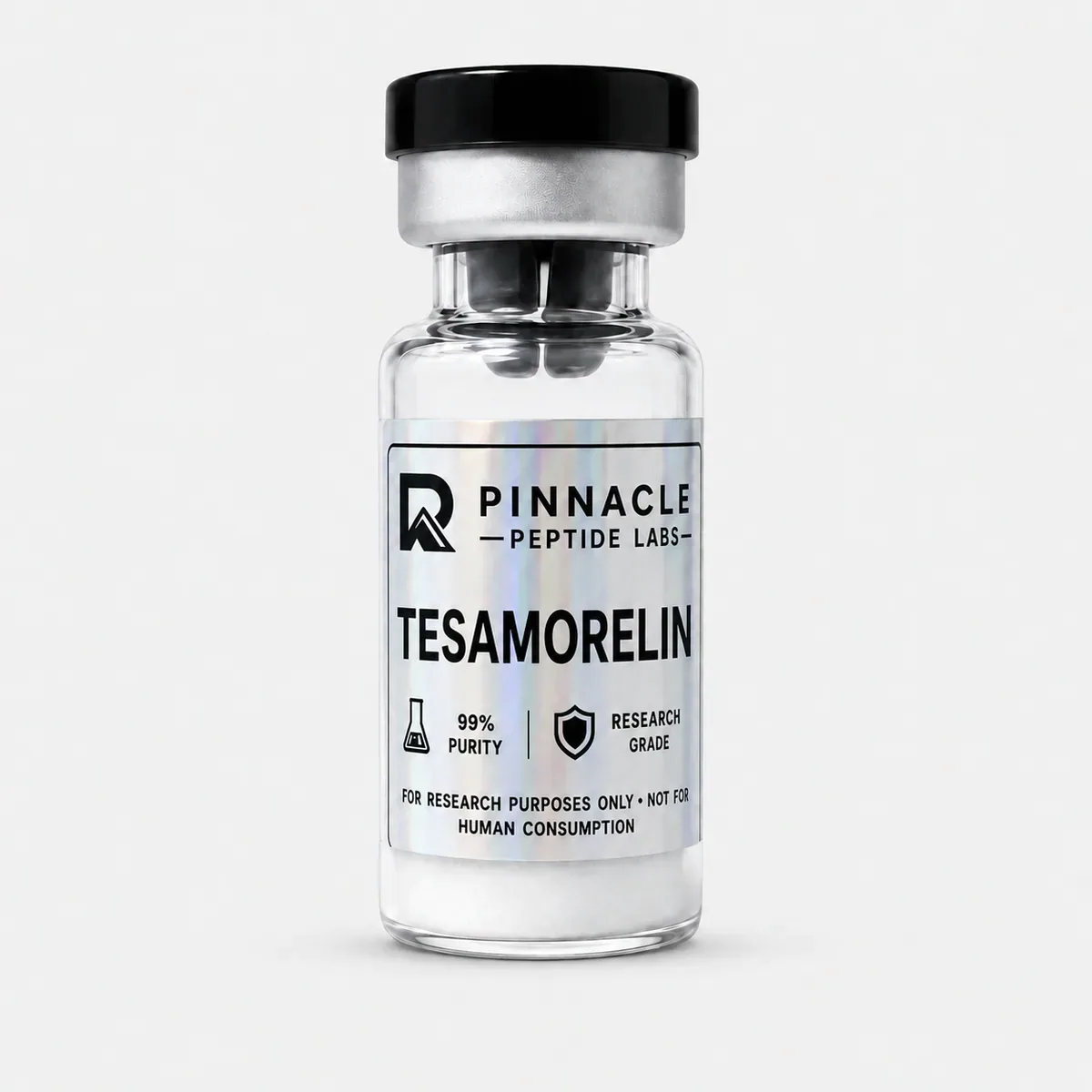
Tesamorelin 10mg
COA included, doctoral chemist tested
A stabilized growth hormone-releasing factor analog studied for its effects on GH secretion pathways in laboratory models.