Cagrilintide: Research Overview and Mechanism
Cagrilintide is a long-acting, acylated amylin analog studied for its interactions with the amylin and calcitonin receptor families. In laboratory and preclinical research it is investigated within satiety signaling and energy-homeostasis models, often alongside incretin peptides. It is supplied as a lyophilized powder for research use only and is not approved for human use.
What Cagrilintide is
Cagrilintide is an acylated, disulfide-bridged analog of amylin, a peptide hormone. In research it is studied as a long-acting agonist across the amylin and calcitonin receptor families, which are structurally related. The two sulfur atoms in its molecular formula correspond to a cysteine-cysteine disulfide bridge that stabilizes the amylin-analog structure, a feature studied in peptide structure-function research.
Its fatty-acid acylation is studied as a half-life-extending feature, which is the basis for describing it as long-acting. The exact sequence and salt form should be confirmed against the supplier Certificate of Analysis before values are used in research.
Pathways it is studied within
Research using Cagrilintide examines amylin-receptor and calcitonin-receptor signaling within satiety and energy-homeostasis endpoints in preclinical models. The amylin receptors it engages are heteromeric complexes formed when the calcitonin receptor associates with receptor activity-modifying proteins (RAMPs), which is the structural reason a single analog is studied across both the amylin and calcitonin receptor families. Because amylin and incretin pathways are complementary, Cagrilintide is frequently studied alongside GLP-1 and dual-receptor peptides in the same metabolic-research area.
These are described as research applications reported in the literature, not human outcomes. Under its development code AM833, the compound has also been investigated in human clinical trials, including combination research with the GLP-1 receptor agonist semaglutide; it remains investigational and is not approved for human use. It is used as a tool for isolating amylin-pathway contributions within broader metabolic models.
Research literature
The development of the compound as a long-acting amylin analog, identified as AM833, was described in a 2021 report in the Journal of Medicinal Chemistry that detailed the structure-activity work behind its fatty-acid acylation and its receptor potency in preclinical characterization. This overview refers to that research record and does not describe a human effect.
Handling and documentation
Pinnacle Cagrilintide ships as a 5mg lyophilized powder whose molecular formula C194H312N54O59S2 carries two sulfur atoms, the cysteine-cysteine disulfide bridge central to its stability. Store the powder at -20°C protected from light; after reconstituting with bacteriostatic water, refrigerate the solution and avoid the vigorous shaking that can stress a disulfide-bridged structure. Each batch is independently tested by HPLC and mass spectrometry and ships with a lot-matched Certificate of Analysis verifying identity and 99% or higher purity, against which the exact sequence and salt form should be reconciled.
All products are intended strictly for in-vitro laboratory research and development use only. Not for human or veterinary use, not a drug, food, or cosmetic, and not intended to diagnose, treat, cure, or prevent any disease.
Related research peptides
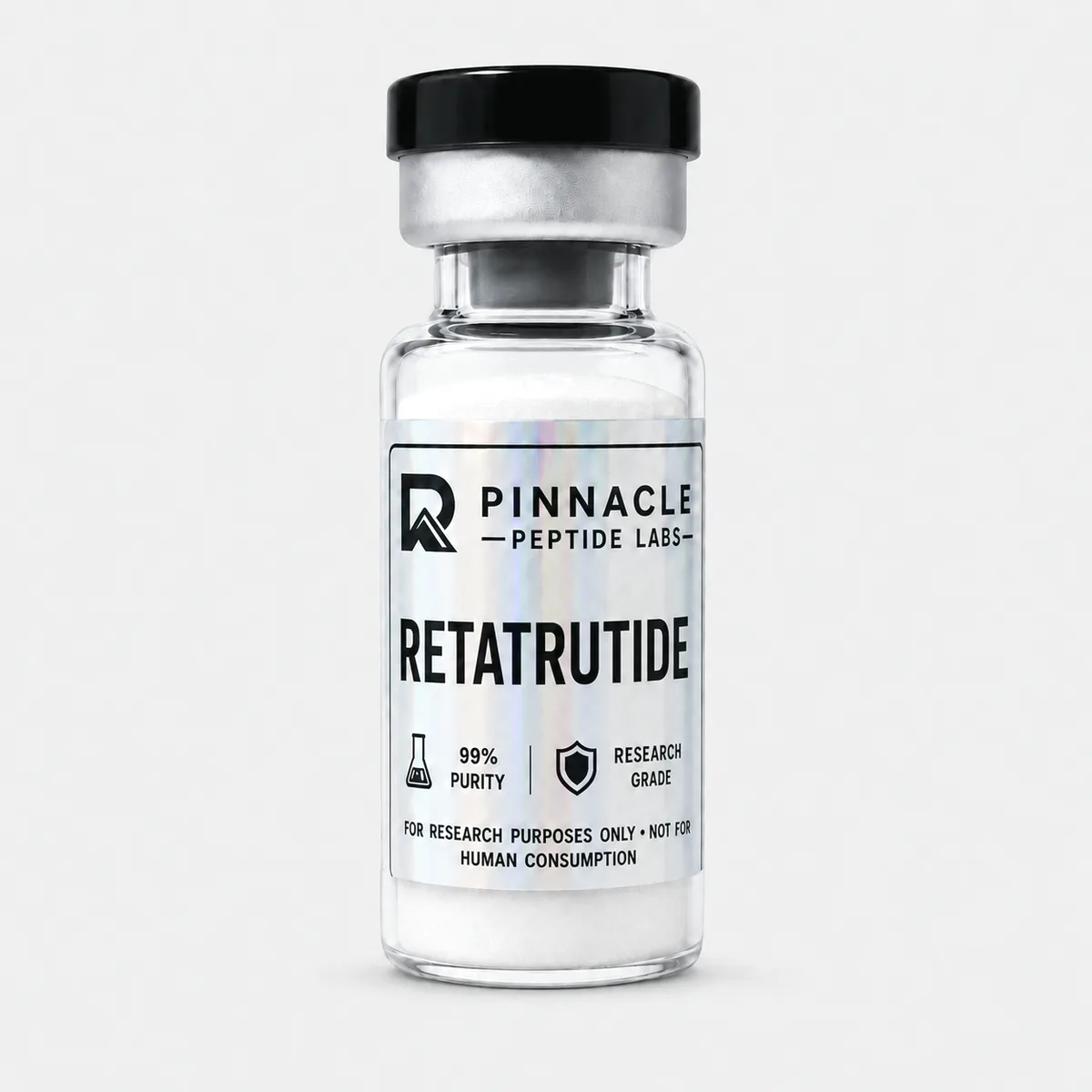
GLP-3RT 20mg
COA included, doctoral chemist tested
A next-generation triple-receptor agonist studied within metabolic, glucose-regulation, and energy-homeostasis research pathways.